
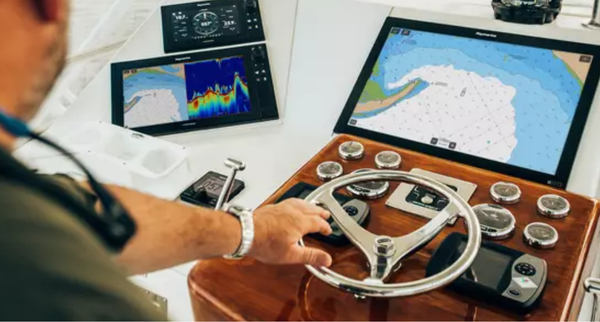
Marine electronics took another big step forward in 2026. Faster processors, easier interfaces, improved charting, better touchscreen performance and features that used to be reserved for much larger boats are making their way onto more helms.
For boaters heading into 2027, the question isn’t just, “What’s new?” It’s whether those improvements are worth replacing the electronics already on your boat.
Here are a few of the biggest developments we’ve been watching.
Furuno Brings More Capability to Smaller Boats
Furuno introduced the TZMAP9 and TZMAP13, standalone 9-inch and 13-inch multifunction displays designed to bring its TZ MAPS platform and advanced navigation features to smaller boats without requiring a complicated networked system.
The displays include built-in fish-finder capability, support CHIRP Side-Scan, can integrate with compatible Furuno radar systems, and come with NOAA vector charts for U.S. coastal waters. Furuno says the TZMAP line is designed for boats starting around 16 feet and up.
That makes the line especially interesting for center consoles, bay boats and other boats where the owner wants better navigation and fish-finding capability without building an oversized electronics package.
Simrad Moves Forward With NEON
Simrad’s NSO 4 represents a major update on the larger-boat side of the market.
The NSO 4 runs Simrad’s newer NEON operating system and uses an 8-core processor. Simrad is positioning it as the center of a fully integrated helm, with support for radar, sonar, autopilot, engine information, cameras and other onboard systems.
It is available in larger display formats and is aimed primarily at offshore boats, larger center consoles, sportfishing boats and yachts.
For owners running an older Simrad system, the bigger change may not simply be screen size. The new operating system, faster response and ability to integrate more of the boat into one interface can make the entire helm feel different.
Raymarine Axiom 2 Gets Faster
Raymarine also updated one of its most recognizable product families with the Axiom 2.
Axiom 2 is available in 7-, 9- and 12-inch sizes and moves to a 6-core processor, with Raymarine reporting faster chart rendering than the previous generation. It also adds upgraded networking, increased internal storage and Raymarine’s HydroTough display coating, which is designed to improve touchscreen reliability when the display is wet.
For boaters who already use Raymarine radar, sonar, cameras or other connected equipment, that improved performance may make an Axiom 2 upgrade particularly attractive.
So, Is It Time to Upgrade?
Not every boat needs the newest display just because something new came out.
If your current electronics still do everything you need, respond quickly and integrate properly with the rest of the boat, there may be no reason to replace them immediately.
But an upgrade starts making more sense when you’re dealing with:
- Slow chart loading or an aging processor
- Older or difficult-to-read displays
- Sonar or radar technology you want to improve
- Limited compatibility with newer equipment
- Outdated networking
- Touchscreens that have become difficult to use
- A helm made up of several generations of equipment that no longer work together smoothly
Sometimes replacing one display is enough. Other times, it makes more sense to look at the helm as a complete system.
Florida’s Offseason Can Be the Perfect Upgrade Window
Here in Florida, we see another pattern every year.
For some of our customers, fishing slows down when hunting season starts. That means the boat finally spends enough time sitting still to take care of the electronics projects that kept getting pushed off during fishing season.
That can be the perfect time to upgrade displays, sonar, radar, AIS, networking or an entire helm without giving up valuable time on the water.
It also gives you time to learn the new system before fishing picks back up.
Before You Start Buying Equipment
The newest unit isn’t automatically the right unit for your boat.
Before upgrading, look at the entire system: your current displays, transducers, radar, autopilot, networking, available dash space and what you actually want the boat to do.
A little planning before the installation can prevent you from replacing equipment that could have been reused or buying a new component that doesn’t integrate the way you expected.
If you’re thinking about updating your marine electronics heading into 2027, talk with our team. We can review what you currently have, what you want to accomplish and help build an upgrade plan that makes sense for your boat.
Ready to upgrade? Shop marine electronics and equipment at RightSideMarine.com.
